We spent a lot of time in Europe out in scenic and rural areas, but we also visited a number of cities and towns.
I like cities and towns. I like the fact that there are buildings and communities close together, overlapping, bumping into one another, layering each other, changing over long periods of time. I like the fact that there are all sorts of people in one place, people who are not like each other much. I like that you can be as anonymous or as known as you want in a city, and that you have access to services, products and events – even if you never use them or go to them. I have always been a city person rather than a country one, and I was glad we got to see that aspect of England and Sweden too.
Our first exploration of the urban environment came when we left Hasselbacka and drove south toward Gothenburg. We stopped for lunch in Uddevala, where we learned a very important fact about Sweden: if you want to go to the bathroom in a public place, you’d best have 5 crowns. That’s about 70 cents, American. I’m not sure how they came to this conclusion – it’s a remarkably uniform price across the country, as we discovered – but there it is. It might be a recycling fee, for all I know. But they’ve got you, so you learn to keep a stack of SEK 5 coins, which are about the size of a US half dollar, in your pocket at all times.
It was rainy in Uddevala, but still – the city had its charms. I liked the bike rack.
Gothenburg was more fun.
We were actually looking forward to Gothenburg for a number of reasons. For one thing, Kim spent eight months there on an internship before she went to graduate school, so she had happy memories of the place. Sara lived there for a while as well, and Mats went to college there, at Chalmers. These days Mats’ brother Lars – who had not made it up to Hasselbacka while we were there – lives in Gothenburg with his family, so we would get a chance to see them before heading back to Stockholm.
Gothenburg – what’s not to like?
Our first mission was to have dinner, so naturally we went to a place that advertises itself as a Danish steakhouse. Because Denmark is, well, not close really, but technically not all that far away. Kind of. I’m not sure why Danish steak is different from Swedish steak, but it was, in fact, very good food. We got to hang out with Lars and his family – including the new baby – too, which was nice. After dinner we walked around the city for a bit.
I’m not really sure who the statue is other than that his name was Gustav, which is not really all that distinguishing in Sweden. There’s a lot of Gustavs in that part of the world, many of whom have statues of their own. The fact that his middle name was Adolf doesn’t help any. It would be like someone named John David Somethingorother in the US, but with a snazzier hat.
We spent the night at the Hotel Linne.
The Hotel Linne – named for Carl Linnaeus, the Swedish scientist – is a student dormitory, though for what college I never did find out. In the summer it becomes a youth hostel. There’s nobody on staff there except for 3-5pm, so it’s kind of serve-yourself.
We got one room, Mats and Sara and their kids got another room, and we met in the kitchen area for snacks and breakfast. You meet all sorts of people at these hostels, and most of them are quite friendly. I ended up talking to a Dutch woman about the Articles of Confederation for a while, which only goes to show you something I’m sure.
The next day we began our explorations of Gothenburg at Slottskogen, a big park just up the street from the hostel. It was a gorgeous day, and the kids had a grand time running around on the equipment while the adults relaxed and watched.
If you were willing to walk a bit – often steeply uphill – you could explore other areas of the park. There was a nice cafe, an area where you could go on a pony ride, and a children’s petting zoo.
Before we left Gothenburg we took a short tour of the city, through Chalmers’ campus (which has changed a bit since Mats was there) and across to the statue of the Big Naked Guy.
The story of the Big Naked Guy, as we understand it, is that the original sculpture was considered rather excessively endowed by some of the local art critics, so they forced the sculptor to circumcise it with a weed-whacker. This reduced the offending member to what was considered an acceptable size, and the statue was allowed to remain. Except that it has a rather nautical theme and the Big Naked Guy is holding a Big Spouting Fish, and if you position yourself just right (i.e. pretty much anywhere not directly in front of or behind the Big Naked Guy), it looks like a rather artistic version of what was lopped off in the first place.
And it’s spouting. So there.
So now it’s something of a tourist attraction, and with any luck the original art critics have learned their lesson about annoying the sculptor.
The other city we spent a lot of time in while we were in Sweden was, not surprisingly, Stockholm. We rode around its buses and subways, and walked through much of its center – it’s a lovely city, especially if you like water. It’s built on an archipelago and pretty much everywhere you look there are boats and bridges.
We spent most of our time in Stockholm wandering the streets of Gamla Stan, which is Swedish for “Old City.” It’s the original core of the city, and it is mostly cut off from vehicular traffic so pedestrians rule – which is good, given the narrow roads.
Some of which are narrower than others.
If you look carefully, between the rearmost lanterns, you can see the blue rubber alien that was hanging down from somewhere up above. There might be a coherent story that would explain it, but if there is we never heard it. It’s just one of those things that happen in cities.
Stockholm is a lovely city.
There were even street musicians – the two most memorable were playing something called a “hang,” which looks like a large wok that had been used as a slingshot target and sounds like a steel drum. Oddly enough, it was nice music.
Our first day there we wandered around until we found a tiny little courtyard, one that had probably been built sometime in the 17th century. Several tiny lanes led into it, and you could sit quietly on a bench and look up into the spreading chestnut tree above you.
Our second day there was more touristy, which was fine considering that we were, in fact, tourists. Some people get rather put out by that label, but I say go with it – you have more fun that way.
Our first order of business was to go down to the Swedish Royal Palace to watch the changing of the guard. We weren’t sure how that was going to play out – the pinnacle of such things is in London – but Mats had served his time in the Swedish military and had taken his turn at the palace, so we had a good guide.
It turns out that even with the informed commentary, it wasn’t that interesting. There were soldiers and musicians moving around in formation, and hordes of camera-wielding tourists (including your narrator) not really seeing any of it. Plus it was chilly and windy. So we left and bought sweatshirts instead.
There’s a lot to see in Gamla Stan. There are all sorts of little shops, for example. Some sell unique and lovely items, but most of them sell the same sort of tourist tchotchkes as you would find in most places, with the word “Sweden” where the word “London” or “New York” or “France” would otherwise be. You can complain about that if you want, but I find such places fascinating. There are little alleyways and broad streets, buildings that are older than the United States (even if you count the Spanish explorations) and buildings still under construction. And there are people everywhere, as far as the eye can see. It’s just glorious.
You’re also never too far away from entertainment in a city.
One of our stops was the Polkagriskokeri, which surprisingly enough does not feature accordions. A polkagris is one of the original forms of candy sticks or candy canes, and they make them there from scratch, by hand, right in front of you. They start with the sugar syrup, and about 20 minutes later there is candy you can eat – it was mesmerizing.
We must have stood there for 45 minutes, and then we bought them out of stock. Or at least it seemed that way. They have an incredible range of flavors – peppermint, violet, apple, strawberry, sour strawberry, “super sour,” mojito, blueberry, “American cola,” tutti-frutti, licorice, and so on. They even have the traditional Swedish salt licorice, which is exactly what it sounds like – a strong licorice flavor drenched in salt. I tried one – it’s a very popular flavor, and they even have it mixed with other flavors, such as raspberry – and I have to say it was, well, awful. Seriously, thoroughly, spit-it-into-the-street-and-chew-on-your-sleeves-to-get-the-taste-out awful. But popular in Sweden.
Eventually we walked over the bridge (which bridge? The nearest one. In a city of islands, there are a lot of them) into the part of Stockholm called “the City.” We had to dodge the lions guarding the entrance to do so. Fortunately, this was not difficult.
We wandered around visiting the various shops and buying many postcards that we never got around to sending as well as a handful of other things (most of the bookstores have English-language sections, though we didn’t buy many books since lugging them across the Atlantic is something of an incentive barrier). Eventually we found an outdoor cafe and sat down for a while.
But rumor had it that a block or so away was a giant outdoor market, so Kim, Tabitha and I went forth and found it.
The venders spend most of their time shouting at you about how wonderful of a deal you'll get if you buy from them and not the con artists in the next stand over - in whatever language they think you speak, from Swedish to English to French to Polish - and eventually we decided to get something to eat. And then we enjoyed the fruits of our victory.
See what I did there? Fruits? I kill me.
The other town we visited was Mariefred, which is within walking distance of Grippsholm Castle. It’s a picturesque little town, and a nice break from all those portraits.
That’s the town hall. It’s painted in Swedish Yellow, so it fits right in.
The neat part of Mariefred is the old church.
If you look carefully, you can see the date it was built right there on the tower – 1624. They were closing up when we walked by, but the curator was willing to let us in so long as we left by the side door, which is apparently much easier to lock. It was lovely inside too.
Saturday, August 4, 2012
Thursday, August 2, 2012
The Sodanator X5000
So it turns out that getting your carpet cleaned takes an extra $35, because you can’t move anything back to where it was until everything dries, so you have to go out to eat.
Fortunately, we had shopping to do anyway.
We’ve been meaning to get our carpets steam cleaned for several years now, and for some reason this week was the week. I suppose any week would have been equally good or bad, really. But now everything is all over, the cats are more paranoid than they usually are, and all of the rooms smell like detergent. So we left for a while.
We did most of our back to school shopping (I know! That’s just MONTHS away, right? Right? Hello? Is this thing on?), and then stopped off at our local fast food noodle place for dinner.
The girls love this place. Love it with the passion of a thousand flaming suns. This place apparently has the world’s best mac and cheese, and my children are connoisseurs of mac and cheese. I’m okay with that, as long as it is not mac and cheez. My basic philosophy of life does not include any space for cheese products spelled with a "z".
There's a new soda machine.
The old one was pretty much the standard fast-food soda machine, with eight different fountains and an ice dispenser in the middle. It did the job, and required no particular skills. You could go right up to it and get whatever you wanted, so long as it was one of eight things (nine if you counted water).
The new one, though, is designed to give you everything you want and more. It's a sleek silver bit of technology with only one large spout, right in the middle, and an ice dispenser behind it that never quite shuts off (technology: what doesn't quite work). But right above the spout there is a touch-screen monitor which displays the logos for about two dozen different kinds of soda. And when you push the one you want, you get another set of logos giving you half a dozen different flavors you can add to it. Orange Coke Zero? Sure! Lemon? Why not? Raspberry vanilla? If you insist…
Let’s just say I spent the rest of the evening burping.
So many choices! So many things to try! TRY ALL THE SODAS!
That can’t be healthy.
Fortunately, we had shopping to do anyway.
We’ve been meaning to get our carpets steam cleaned for several years now, and for some reason this week was the week. I suppose any week would have been equally good or bad, really. But now everything is all over, the cats are more paranoid than they usually are, and all of the rooms smell like detergent. So we left for a while.
We did most of our back to school shopping (I know! That’s just MONTHS away, right? Right? Hello? Is this thing on?), and then stopped off at our local fast food noodle place for dinner.
The girls love this place. Love it with the passion of a thousand flaming suns. This place apparently has the world’s best mac and cheese, and my children are connoisseurs of mac and cheese. I’m okay with that, as long as it is not mac and cheez. My basic philosophy of life does not include any space for cheese products spelled with a "z".
There's a new soda machine.
The old one was pretty much the standard fast-food soda machine, with eight different fountains and an ice dispenser in the middle. It did the job, and required no particular skills. You could go right up to it and get whatever you wanted, so long as it was one of eight things (nine if you counted water).
The new one, though, is designed to give you everything you want and more. It's a sleek silver bit of technology with only one large spout, right in the middle, and an ice dispenser behind it that never quite shuts off (technology: what doesn't quite work). But right above the spout there is a touch-screen monitor which displays the logos for about two dozen different kinds of soda. And when you push the one you want, you get another set of logos giving you half a dozen different flavors you can add to it. Orange Coke Zero? Sure! Lemon? Why not? Raspberry vanilla? If you insist…
Let’s just say I spent the rest of the evening burping.
So many choices! So many things to try! TRY ALL THE SODAS!
That can’t be healthy.
Our Trip to Europe: English Museums (and a Circus!)
Sweden, of course, is not the only place in Europe with museums. It turns out that England is also full of them, and in between visiting historical sites (and occasionally while visiting historical sites) we took in a few of them.
The first one was the Corinium Museum in what is now Cirencester, though once upon a time the city was called … wait for it … Corinium. It was one of the bigger Roman towns in England, and while the museum does deal with all of the history of Cirencester (generally shortened to “Ciren,” which rhymes with Siren), it does focus pretty hard on the Roman stuff. As you would expect.
This is the building, or at least part of it.
Already you know one thing about the place: it’s in the Cotswolds. Everything in that part of England is built out of that same brown stone, which gives a certain uniformity to the region.
We went in through the main entrance, which you can just see to the right of the building in the center of the above photo (the museum continues on to the right, out of frame, and well to the rear), paid our fees, and embarked on our tour of history.
There’s a lot of it.
All of that is Roman. The mosaics are all over the place, and there are so many inscribed stones that they’re hard to keep track of, really. What’s neat about it all, as you can see with Tabitha above, is that a lot of the things are just out there on the floor where you can touch them. There’s something to be said about actually being able to touch history.
Of course, eventually you reach your fill.
We also stopped at the gift shop, because that’s what we do. We like gift shops.
We also went to visit the Roman bath, in the city of, well, Bath. Go figure.
The Roman bath is an astounding thing to see for both its ancient and modern elements. For one thing, you go into the museum through what I regard as the greatest entrance of any entrance in the history of entrances.
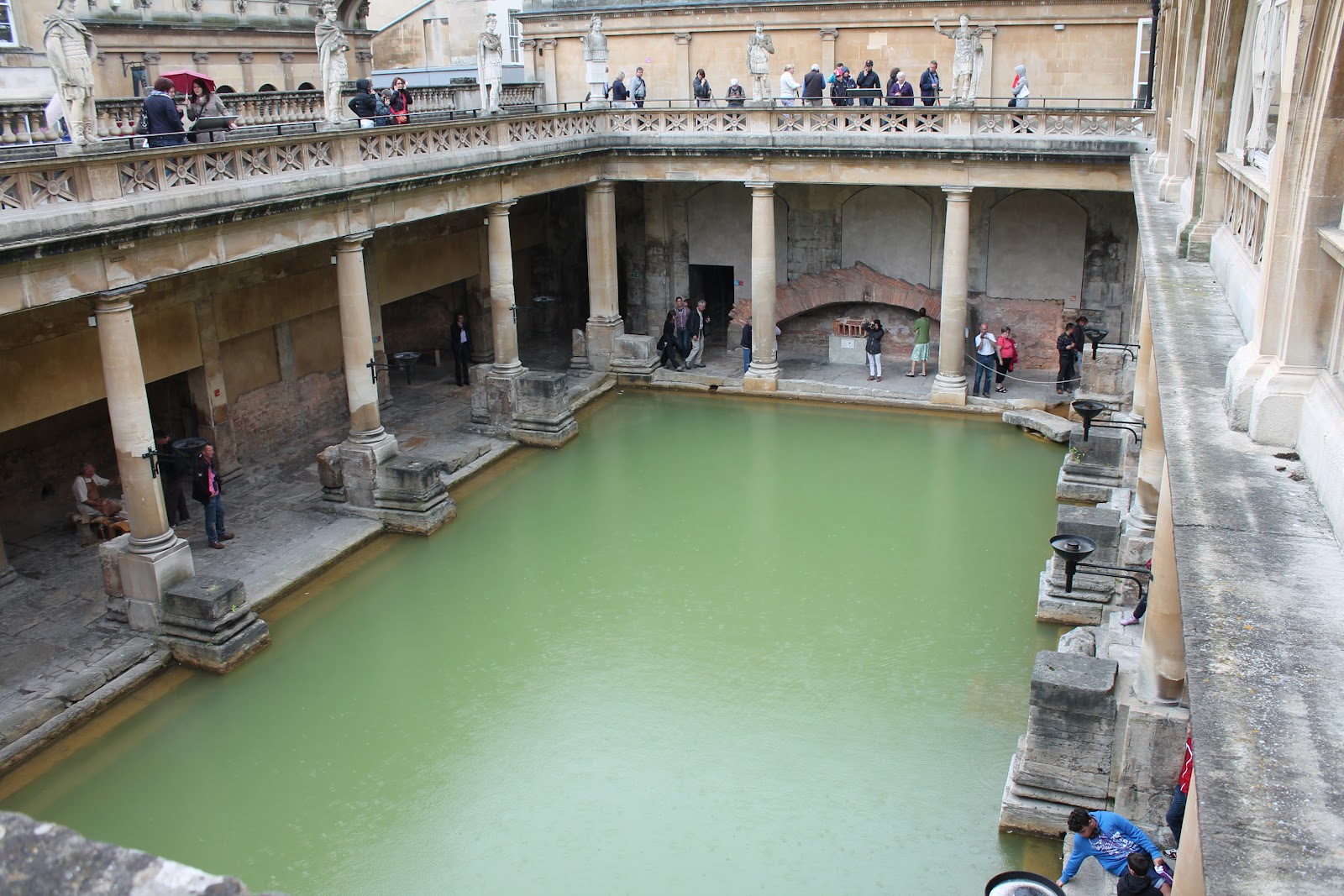
This takes you to a balcony where you can look out over the bath itself.
The bath is built on a natural hot spring, so the water is always warm. It is also full of minerals – that’s its natural color and not some cheap St. Patrick’s Day stunt. It also tastes really, really bad – there is a fountain in the museum where they divert some of the spring’s flow and invite you to drink some. As Magnus said when Lauren and I tried it, “It’s something you do mostly to say you’ve done it.”
Up on the balcony there are all sorts of nineteenth-century statues. It was chilly that day, and one of the two days we had in England where the rain never really did let up.
The museum funnels you through all sorts of exhibits, some of them showing you how the plumbing system worked (which was fascinating) and some of them showing you a wide assortment of artifacts that were recovered on the site or around Ciren.
My favorite artifact was this one.
According to the sign next to it, the inscription says, “This holy spot, wrecked by insolent hands and cleansed afresh, Gaius Severius Emeritus, Centurion in charge of the region, has restored to the Virtue and Deity of the Emperor.” How annoyed do you have to be to carve that kind of invective into stone?
Eventually the museum funnels you back to the bath, this time at ground level.
There is a tiny little sign tucked well back in a corner that says you shouldn’t touch the water, but we figured if they really meant it they would have made more of an effort. You know what? It was warm.
We had to rush through the museum a bit, because we were on something of a schedule. We had to get to Giffords Circus, which isn’t a museum but I’m going to put it here because it really doesn’t fit anywhere else. And that, really, is part of its charm.
If you are ever in the Cotswolds, you really should seek out and attend a performance of the Giffords Circus. You will thank me for this advice. The Giffords Circus is an old-fashioned, one-ring tent circus, with acrobats, horses, jugglers, a live band composed almost entirely of women in vast 19th-century undergarments, and a vaudevillian clown – the kind that is actually funny, rather than the creepy Bozo variety. It’s a deliberate throwback to the circuses of the 1920s and earlier, and it is just the most fun you will ever have in a tent with your clothes on.
We had to find it first, which meant zipping our way from Bath to the Trout Inn, just outside the tiny little town of Lechlade, all in a driving rainstorm that made the grounds a quagmire when we got there. But it was so worth it.
It was the sort of show where when the acrobats weren’t happy with the way they did a trick, they motioned to the band for a repeat and did it again. Nothing was photoshopped, and it was refreshing to be able to tell from looking just how difficult and how much training each routine was. In this digital age, that’s priceless.
At intermission you could go out into the pouring rain to the carts they had set up to sell souvenirs and hot food (including pizza, cooked in ovens for which Richard had processed the patent application). Or you could stay in the tent and buy snacks directly from the Feather Ladies, who doubled as ushers and what passed for security during the show itself.
After the show they invited all of the children down to the ring for dancing.
Go see them. You will not be disappointed.
Our final museum in England was at Avebury. It was only a small part of the experience, but it was interesting. After we had looked at the standing stones to our fill we found that they had a museum in two parts, the most interesting one being inside a 17th-century threshing barn.
They had a very well laid out timeline of the history of the region from the Bronze Age to the 20th century, all with appropriate artifacts. There was also a section on the guy who found and preserved the standing stones, who was an interesting figure in his own right. And there were the two old beams that were holding up one end of the barn.
We were told that those beams dated back to 1066 or so, and we have no reason to doubt it.
The first one was the Corinium Museum in what is now Cirencester, though once upon a time the city was called … wait for it … Corinium. It was one of the bigger Roman towns in England, and while the museum does deal with all of the history of Cirencester (generally shortened to “Ciren,” which rhymes with Siren), it does focus pretty hard on the Roman stuff. As you would expect.
This is the building, or at least part of it.
Already you know one thing about the place: it’s in the Cotswolds. Everything in that part of England is built out of that same brown stone, which gives a certain uniformity to the region.
We went in through the main entrance, which you can just see to the right of the building in the center of the above photo (the museum continues on to the right, out of frame, and well to the rear), paid our fees, and embarked on our tour of history.
There’s a lot of it.
All of that is Roman. The mosaics are all over the place, and there are so many inscribed stones that they’re hard to keep track of, really. What’s neat about it all, as you can see with Tabitha above, is that a lot of the things are just out there on the floor where you can touch them. There’s something to be said about actually being able to touch history.
Of course, eventually you reach your fill.
We also stopped at the gift shop, because that’s what we do. We like gift shops.
We also went to visit the Roman bath, in the city of, well, Bath. Go figure.
The Roman bath is an astounding thing to see for both its ancient and modern elements. For one thing, you go into the museum through what I regard as the greatest entrance of any entrance in the history of entrances.
This takes you to a balcony where you can look out over the bath itself.
The bath is built on a natural hot spring, so the water is always warm. It is also full of minerals – that’s its natural color and not some cheap St. Patrick’s Day stunt. It also tastes really, really bad – there is a fountain in the museum where they divert some of the spring’s flow and invite you to drink some. As Magnus said when Lauren and I tried it, “It’s something you do mostly to say you’ve done it.”
Up on the balcony there are all sorts of nineteenth-century statues. It was chilly that day, and one of the two days we had in England where the rain never really did let up.
The museum funnels you through all sorts of exhibits, some of them showing you how the plumbing system worked (which was fascinating) and some of them showing you a wide assortment of artifacts that were recovered on the site or around Ciren.
My favorite artifact was this one.
According to the sign next to it, the inscription says, “This holy spot, wrecked by insolent hands and cleansed afresh, Gaius Severius Emeritus, Centurion in charge of the region, has restored to the Virtue and Deity of the Emperor.” How annoyed do you have to be to carve that kind of invective into stone?
Eventually the museum funnels you back to the bath, this time at ground level.
There is a tiny little sign tucked well back in a corner that says you shouldn’t touch the water, but we figured if they really meant it they would have made more of an effort. You know what? It was warm.
We had to rush through the museum a bit, because we were on something of a schedule. We had to get to Giffords Circus, which isn’t a museum but I’m going to put it here because it really doesn’t fit anywhere else. And that, really, is part of its charm.
If you are ever in the Cotswolds, you really should seek out and attend a performance of the Giffords Circus. You will thank me for this advice. The Giffords Circus is an old-fashioned, one-ring tent circus, with acrobats, horses, jugglers, a live band composed almost entirely of women in vast 19th-century undergarments, and a vaudevillian clown – the kind that is actually funny, rather than the creepy Bozo variety. It’s a deliberate throwback to the circuses of the 1920s and earlier, and it is just the most fun you will ever have in a tent with your clothes on.
We had to find it first, which meant zipping our way from Bath to the Trout Inn, just outside the tiny little town of Lechlade, all in a driving rainstorm that made the grounds a quagmire when we got there. But it was so worth it.
It was the sort of show where when the acrobats weren’t happy with the way they did a trick, they motioned to the band for a repeat and did it again. Nothing was photoshopped, and it was refreshing to be able to tell from looking just how difficult and how much training each routine was. In this digital age, that’s priceless.
At intermission you could go out into the pouring rain to the carts they had set up to sell souvenirs and hot food (including pizza, cooked in ovens for which Richard had processed the patent application). Or you could stay in the tent and buy snacks directly from the Feather Ladies, who doubled as ushers and what passed for security during the show itself.
After the show they invited all of the children down to the ring for dancing.
Go see them. You will not be disappointed.
Our final museum in England was at Avebury. It was only a small part of the experience, but it was interesting. After we had looked at the standing stones to our fill we found that they had a museum in two parts, the most interesting one being inside a 17th-century threshing barn.
They had a very well laid out timeline of the history of the region from the Bronze Age to the 20th century, all with appropriate artifacts. There was also a section on the guy who found and preserved the standing stones, who was an interesting figure in his own right. And there were the two old beams that were holding up one end of the barn.
We were told that those beams dated back to 1066 or so, and we have no reason to doubt it.
Wednesday, August 1, 2012
Our Trip to Europe: Swedish Museums
One thing we did fairly often during our trip was go to museums.
We like museums. They’re full of just the darndest things, they are often painlessly educational, and most of them have gift shops to appease the tchotchke lover in all of us. What’s not to like? So when we weren’t going to actual historic sites we were often visiting sites devoted to history, which is almost but not quite the same.
We saw several in one day while we were in Stockholm.
In the morning we took the subway and bus into the city to see the Toy Museum, except that it isn’t just the Toy Museum – and if you just went by what was on the outside you wouldn’t know it was a Toy Museum at all, because the sign says Transportation Museum (Well, actually it says Sparvagsmuseet, with a circle over the first “a” and an umlaut over the second, but that’s only because it’s in Sweden.) The Toy Museum, it turns out, is located in the back of the Transportation Museum.
I’m sure this makes sense to someone.
We decided to split up when we got there, so Kim, Sara, Mats, Lauren, Maria and Helena went dashing off to the Toy Museum while Tabitha and I explored the Transportation side of things.
If you’ve never been there (and really, who hasn’t?), the Transportation Museum is quite a wonder. It is a giant barn of a place dedicated to public transportation in its many forms in Stockholm since the late 1800s. It contains several dozen full-sized trolley and light rail cars, some of them so old that they were made of wood.
There are even a few that were horse-drawn, and these are duly tethered to stuffed horses so you can see how it worked. There are also buses – a complete set going back to the 1910s. And if you’ve lost your way, they have the complete selection of signs. It’s like a Swedish M*A*S*H.
There is also a good-sized section way in the back devoted to both the design elements of Stockholm’s public transportation system (logos, uniforms, typefaces for station signs, and so on) and Lego recreations of a number of stations. Each of the Lego recreations was about four feet square. Someday Lego will make faces for its people figures that actually smile, though perhaps a scowl was appropriate for a late Lego commuter.
I’m still not sure why those things were linked together in one display area, but then given the larger disparity of museums under this roof that does seem like a quibble.
When we’d finished looking at the trains and buses (which are surprisingly fascinating – it took us some time) Tabitha and I headed over to the Toy Museum part of the building. This part is much smaller, and jam packed with just about every toy ever manufactured.
There are sections devoted to dolls. There are sections devoted to model ships. There are board games, fire engines, trains, and a working pinball machine.
There is also this:
This is without a doubt the creepiest Mickey Mouse ever assembled. It’s the Zombie Mickey, starved for brains (you would be too if you hung out with Donald Duck and Goofy most of the time). Or maybe it’s the Zombie Minnie. Either way, I’m sure it was meant well but it is Coraline-grade unsettling.
We got lunch at the museum (a tasty but time-consuming process, given the speed at which the cafe there operated) and then took the bus back toward the old section of Stockholm (“Gamla Stan” – “Old City”) to go to the Medieval Museum.
The Medieval Museum is a classic example of how a small museum can be packed with displays and information without feeling like Fibber McGee’s closet. Museum designers from all over the world should head there immediately and take lessons. It was fascinating.
It’s set up underneath a bridge, where an actual medieval archeological dig took place, and the main room is bisected by a portion of the old city wall still in its original location. That’s the wall in the background in this photo:
The figure in the foreground is dying of the Black Death, and is remarkably powerful when you’re standing right in front of it. The museum actually does a good job of showing the starker aspects of medieval life, with a cemetery exhibit (including bits of the actual medieval cemetery and a skeleton that was found there) and a dark corner devoted to the executioner’s hill. There is also a large boat that was unearthed nearby and a fairly extensive collection of weapons.
Of course, not everything is so grim.
I’m not really sure who this figure is supposed to be, but he was just too silly not to take this photo.
We spent several hours in the Medieval Museum, and it flew right by. They had a recreation of a medieval street, a house you could climb up into, and – rather incongruously – a temporary exhibit bemoaning the evils of genetically modified foods, which fit into the medieval world only with difficulty but there you go.
On the outside wall of that exhibit was a map showing the trade routes used by medieval Swedish merchants and what they obtained using them. Stockholm, by virtue of its location, tended to trade with its Baltic neighbors and with Russia, while Goteborg, on the west coast, tended to trade with the Danes, the English, and the Germans. It was quite interesting, but it didn’t really explain the illustration of the bear that Lauren is pointing to in what is now Finland.
That’s one sick bear.
On our last full day in Sweden we went to Haga Park to see the Fjarilshuset (umlaut over the “a”), which translates more or less to Butterfly House.
It turned out that there was a rather critical lack of butterflies, but there were loads of fish.
And we did eventually find the butterflies.
There are also a number of flightless birds hopping about, a wide assortment of plants, and probably a few other things that I missed. They have to keep the place hot and humid so that the critters stay comfortable. On the one hand, it was still considerably cooler than the temperatures back in the US. On the other hand, it was quite muggy for those of us used to the more temperate climate of Scandinavia, and eventually we left to go explore the rest of the grounds.
Haga Park is quite extensive, actually. There are quite literally dozens of historic buildings to visit, ten different museums, and a giant park to wander around in when you get tired of the man-made stuff.
This is the Koppartalten (umlaut over the second “a”). It’s actually a normal building from the back, but for reasons that were never really clear to me somebody slapped a vast quantity of copper sheeting across the front and painted it to look like a circus tent.
There’s a cafe inside.
The fun part for me was the Slottsgrunden, which is down from the Koppartalten, toward the lake (of course there’s a lake – this is Sweden) along the less-used path. This was the foundation of a giant palace, begun under King Gustav III in 1787. Unfortunately Gustav was assassinated in 1792 (it was a bad decade for kings) and the project died with him.
We came to it from the side less traveled, and wandered in. This was probably the courtyard or something similar, since it was only one layer deep.
But if you went past the end there, you found yourself in a three-dimensional playground that must have been meant to be the basement.
Because we came around from the wrong side we didn’t see any of the signs warning us in dire language of the illegal nature of what we were doing among the foundations until it was time to leave, and by then it was too late.
So there.
We continued down to the lake and explored a number of other structures, including the Echo Pavilion.
Apparently this was designed as a picnic spot, and you can in fact stand right in the middle and hear your voice echo.
Who knew?
We like museums. They’re full of just the darndest things, they are often painlessly educational, and most of them have gift shops to appease the tchotchke lover in all of us. What’s not to like? So when we weren’t going to actual historic sites we were often visiting sites devoted to history, which is almost but not quite the same.
We saw several in one day while we were in Stockholm.
In the morning we took the subway and bus into the city to see the Toy Museum, except that it isn’t just the Toy Museum – and if you just went by what was on the outside you wouldn’t know it was a Toy Museum at all, because the sign says Transportation Museum (Well, actually it says Sparvagsmuseet, with a circle over the first “a” and an umlaut over the second, but that’s only because it’s in Sweden.) The Toy Museum, it turns out, is located in the back of the Transportation Museum.
I’m sure this makes sense to someone.
We decided to split up when we got there, so Kim, Sara, Mats, Lauren, Maria and Helena went dashing off to the Toy Museum while Tabitha and I explored the Transportation side of things.
If you’ve never been there (and really, who hasn’t?), the Transportation Museum is quite a wonder. It is a giant barn of a place dedicated to public transportation in its many forms in Stockholm since the late 1800s. It contains several dozen full-sized trolley and light rail cars, some of them so old that they were made of wood.
There are even a few that were horse-drawn, and these are duly tethered to stuffed horses so you can see how it worked. There are also buses – a complete set going back to the 1910s. And if you’ve lost your way, they have the complete selection of signs. It’s like a Swedish M*A*S*H.
There is also a good-sized section way in the back devoted to both the design elements of Stockholm’s public transportation system (logos, uniforms, typefaces for station signs, and so on) and Lego recreations of a number of stations. Each of the Lego recreations was about four feet square. Someday Lego will make faces for its people figures that actually smile, though perhaps a scowl was appropriate for a late Lego commuter.
I’m still not sure why those things were linked together in one display area, but then given the larger disparity of museums under this roof that does seem like a quibble.
When we’d finished looking at the trains and buses (which are surprisingly fascinating – it took us some time) Tabitha and I headed over to the Toy Museum part of the building. This part is much smaller, and jam packed with just about every toy ever manufactured.
There are sections devoted to dolls. There are sections devoted to model ships. There are board games, fire engines, trains, and a working pinball machine.
There is also this:
This is without a doubt the creepiest Mickey Mouse ever assembled. It’s the Zombie Mickey, starved for brains (you would be too if you hung out with Donald Duck and Goofy most of the time). Or maybe it’s the Zombie Minnie. Either way, I’m sure it was meant well but it is Coraline-grade unsettling.
We got lunch at the museum (a tasty but time-consuming process, given the speed at which the cafe there operated) and then took the bus back toward the old section of Stockholm (“Gamla Stan” – “Old City”) to go to the Medieval Museum.
The Medieval Museum is a classic example of how a small museum can be packed with displays and information without feeling like Fibber McGee’s closet. Museum designers from all over the world should head there immediately and take lessons. It was fascinating.
It’s set up underneath a bridge, where an actual medieval archeological dig took place, and the main room is bisected by a portion of the old city wall still in its original location. That’s the wall in the background in this photo:
The figure in the foreground is dying of the Black Death, and is remarkably powerful when you’re standing right in front of it. The museum actually does a good job of showing the starker aspects of medieval life, with a cemetery exhibit (including bits of the actual medieval cemetery and a skeleton that was found there) and a dark corner devoted to the executioner’s hill. There is also a large boat that was unearthed nearby and a fairly extensive collection of weapons.
Of course, not everything is so grim.
I’m not really sure who this figure is supposed to be, but he was just too silly not to take this photo.
We spent several hours in the Medieval Museum, and it flew right by. They had a recreation of a medieval street, a house you could climb up into, and – rather incongruously – a temporary exhibit bemoaning the evils of genetically modified foods, which fit into the medieval world only with difficulty but there you go.
On the outside wall of that exhibit was a map showing the trade routes used by medieval Swedish merchants and what they obtained using them. Stockholm, by virtue of its location, tended to trade with its Baltic neighbors and with Russia, while Goteborg, on the west coast, tended to trade with the Danes, the English, and the Germans. It was quite interesting, but it didn’t really explain the illustration of the bear that Lauren is pointing to in what is now Finland.
That’s one sick bear.
On our last full day in Sweden we went to Haga Park to see the Fjarilshuset (umlaut over the “a”), which translates more or less to Butterfly House.
It turned out that there was a rather critical lack of butterflies, but there were loads of fish.
And we did eventually find the butterflies.
There are also a number of flightless birds hopping about, a wide assortment of plants, and probably a few other things that I missed. They have to keep the place hot and humid so that the critters stay comfortable. On the one hand, it was still considerably cooler than the temperatures back in the US. On the other hand, it was quite muggy for those of us used to the more temperate climate of Scandinavia, and eventually we left to go explore the rest of the grounds.
Haga Park is quite extensive, actually. There are quite literally dozens of historic buildings to visit, ten different museums, and a giant park to wander around in when you get tired of the man-made stuff.
This is the Koppartalten (umlaut over the second “a”). It’s actually a normal building from the back, but for reasons that were never really clear to me somebody slapped a vast quantity of copper sheeting across the front and painted it to look like a circus tent.
There’s a cafe inside.
The fun part for me was the Slottsgrunden, which is down from the Koppartalten, toward the lake (of course there’s a lake – this is Sweden) along the less-used path. This was the foundation of a giant palace, begun under King Gustav III in 1787. Unfortunately Gustav was assassinated in 1792 (it was a bad decade for kings) and the project died with him.
We came to it from the side less traveled, and wandered in. This was probably the courtyard or something similar, since it was only one layer deep.
But if you went past the end there, you found yourself in a three-dimensional playground that must have been meant to be the basement.
Because we came around from the wrong side we didn’t see any of the signs warning us in dire language of the illegal nature of what we were doing among the foundations until it was time to leave, and by then it was too late.
So there.
We continued down to the lake and explored a number of other structures, including the Echo Pavilion.
Apparently this was designed as a picnic spot, and you can in fact stand right in the middle and hear your voice echo.
Who knew?
Once More Unto the Breach, Dear Friends, Once More
Well, I have voted. Again.
We do that here in Wisconsin nowadays. It’s become our favorite sport. We’ve had five elections already this year – primaries and recalls for state senators and for Governor Teabagger (a wholly-owned subsidiary of Koch Industries) as well as the presidential primary that nobody remembers because it was irrelevant by the time it happened. November will be our seventh election.
This current election, our sixth, is the primary for federal, state and local offices for November’s general. We get to choose from a welter of people running for Congress, the State Legislature, and various county offices (Recorder of Deeds!). Sometimes you have to wonder why so many offices are elected, but such is life in the wake of Jacksonian egalitarianism.
We had to vote early, because the actual election will take place on a day when we will be out of town, so Kim and I took the girls over to the County Courthouse here in Our Little Town. It was my first experience with early voting.
It turned out to be not so complicated after all.
They ask your name and some identifying details, and then hand you a ballot. You go over to the little table over in the corner – one of the same ones they use on election day – and fill it in. Then you seal it in an envelope that you’ve already signed at the window, and hand it back. Easy.
Voting should be easy.
It’s a shame that there is a strong movement in this country – localized to a single political party who shall remain nameless because every time I so much as pronounce their initials I get an uncontrollable urge to have their leadership arrested for subversion and frankly my blood pressure doesn’t need that these days – to place unconstitutional and immoral obstructions in front of voters. They claim it is to prevent voter fraud, which is funny since nobody has ever found any significant voter fraud in the US in the last fifty years.
Our own state attorney general – a member in good standing of the offending nameless political party and a man so nakedly partisan that it’s almost refreshing – spent two years and tens of thousands of tax-payer dollars investigating this issue and came up with nothing, and if he can’t find something to advance his own political cause you can bet it doesn’t exist. The Commonwealth of Pennsylvania – my home state – has admitted in court, under oath, that the problem doesn’t exist despite having passed a Wisconsin-style Voter Suppression Act that was supposedly designed to address that problem.
Not that this makes any difference to those pushing such laws. They already knew that.
So I vote.
Again.
We do that here in Wisconsin nowadays. It’s become our favorite sport. We’ve had five elections already this year – primaries and recalls for state senators and for Governor Teabagger (a wholly-owned subsidiary of Koch Industries) as well as the presidential primary that nobody remembers because it was irrelevant by the time it happened. November will be our seventh election.
This current election, our sixth, is the primary for federal, state and local offices for November’s general. We get to choose from a welter of people running for Congress, the State Legislature, and various county offices (Recorder of Deeds!). Sometimes you have to wonder why so many offices are elected, but such is life in the wake of Jacksonian egalitarianism.
We had to vote early, because the actual election will take place on a day when we will be out of town, so Kim and I took the girls over to the County Courthouse here in Our Little Town. It was my first experience with early voting.
It turned out to be not so complicated after all.
They ask your name and some identifying details, and then hand you a ballot. You go over to the little table over in the corner – one of the same ones they use on election day – and fill it in. Then you seal it in an envelope that you’ve already signed at the window, and hand it back. Easy.
Voting should be easy.
It’s a shame that there is a strong movement in this country – localized to a single political party who shall remain nameless because every time I so much as pronounce their initials I get an uncontrollable urge to have their leadership arrested for subversion and frankly my blood pressure doesn’t need that these days – to place unconstitutional and immoral obstructions in front of voters. They claim it is to prevent voter fraud, which is funny since nobody has ever found any significant voter fraud in the US in the last fifty years.
Our own state attorney general – a member in good standing of the offending nameless political party and a man so nakedly partisan that it’s almost refreshing – spent two years and tens of thousands of tax-payer dollars investigating this issue and came up with nothing, and if he can’t find something to advance his own political cause you can bet it doesn’t exist. The Commonwealth of Pennsylvania – my home state – has admitted in court, under oath, that the problem doesn’t exist despite having passed a Wisconsin-style Voter Suppression Act that was supposedly designed to address that problem.
Not that this makes any difference to those pushing such laws. They already knew that.
So I vote.
Again.
Subscribe to:
Posts (Atom)